Digital marketing has always evolved alongside technology. Today, Artificial Intelligence is shaping how campaigns are created, analysed, and optimised.
From automated advertising platforms to AI-generated content, businesses now have access to more tools than ever before.
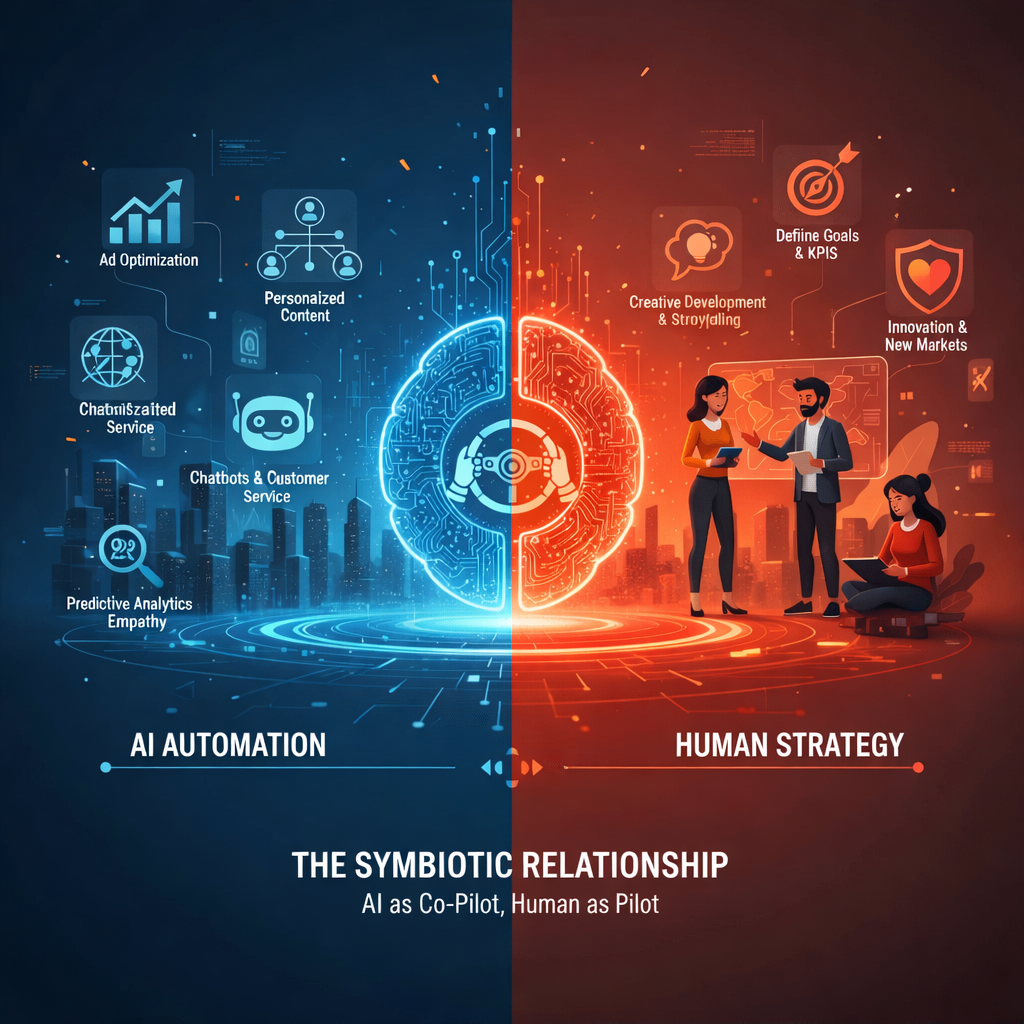
However, while automation improves efficiency, it does not replace strategic thinking.
What AI Brings to Digital Marketing
AI tools are particularly powerful when it comes to data and performance.
For example, they allow marketers to:
- analyse large volumes of advertising data
- generate multiple content variations
- automate audience targeting
- improve campaign efficiency
Because of this, campaigns can be tested and adjusted much faster.
As a result, marketing becomes more flexible and responsive to performance.
The Limits of Automation
Despite these advantages, AI still depends on human direction.
While it can process data quickly, it cannot decide what a business should aim for.
For instance, effective marketing requires answering key questions:
- Who is the ideal customer?
- What message will resonate?
- Which platforms should be prioritised?
- How should the brand stand out from competitors?
These decisions are strategic. They rely on understanding behaviour, business objectives, and long-term positioning.
In contrast, automation focuses on execution.
The Role of Agencies in the AI Era
In this context, digital agencies play a critical role.
They connect technology with business objectives.
At EBOX, the focus is on translating marketing goals into structured strategies that deliver measurable results.
AI supports this process by helping us:
- explore campaign variations
- optimise targeting
- accelerate content production
- analyse performance data
However, the direction always remains human-driven.
We define the strategy, guide the tools, and adjust based on performance.
Why Businesses Still Need Expertise
Many businesses attempt to run campaigns using automated platforms.
While this can generate visibility, it often lacks structure.
Without clear objectives, accurate targeting, and proper analysis, budgets are quickly spent without delivering strong results.
On the other hand, working with experienced professionals ensures that every action is aligned with a clear strategy.
This reduces waste and improves performance over time.
The Future of Digital Marketing
AI will continue to evolve. As it does, automation will become even more accessible.
However, this also increases competition.
Because of this, businesses that rely only on tools will struggle to stand out.
Those that combine technology with strategy will achieve stronger and more consistent results.
Final Thought
Automation improves execution.
However, strategy defines results.
And in digital marketing, results are what matter.
Closing Note
If your objective is not just to run campaigns, but to build a structured and profitable marketing system, strategic direction will always make the difference.