
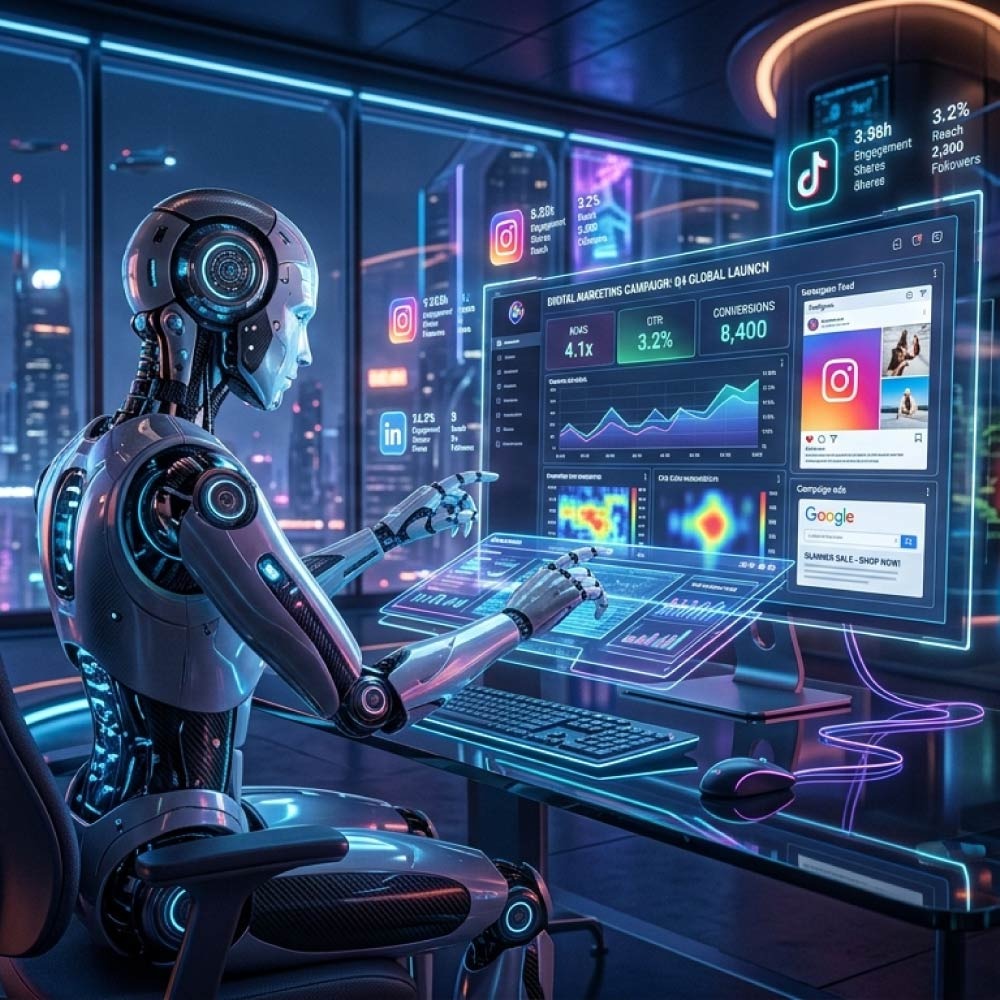
Artificial Intelligence is evolving rapidly. Today, tools can generate websites, design visuals, write articles, edit videos, and even manage advertising campaigns.
As a result, many business owners are asking the same question:
Will AI replace digital marketing agencies?
The short answer is no.
However, the real answer goes deeper.
AI is changing how marketing is executed. It removes repetitive tasks and speeds up production. At the same time, it does not replace the core of digital marketing. Strategy, market understanding, and decision-making still drive real results.
What AI Is Already Replacing
AI performs extremely well when it comes to execution.
For example, tasks that once required hours can now be completed in minutes. These include generating content drafts, creating visuals, analysing data, and assisting with website structures.
Because of this, the role of agencies is evolving.
Instead of focusing on production, agencies now focus more on performance, positioning, and optimisation. In other words, AI does not replace professionals — it allows them to work more efficiently.
Where AI Still Falls Short
Despite its capabilities, AI still lacks several critical elements.
First, strategy.
AI can generate outputs, but it cannot define clear business direction. It does not fully understand positioning, competition, or long-term goals.
Second, customer understanding.
Marketing depends on behaviour, culture, and psychology. For instance, understanding how Mauritian audiences think and respond requires real experience. AI cannot fully replicate that.
Third, accountability.
AI produces suggestions. However, it does not take responsibility for results. Agencies track performance, adjust campaigns, and remain accountable for outcomes.
Finally, long-term direction.
AI executes tasks. Meanwhile, agencies build brands, consistency, and sustainable growth strategies.
Why Businesses Cannot Simply Rely on AI
Many tools promote the idea that marketing can be done instantly.
While this sounds appealing, the reality is different.
A website is not just a collection of pages. Instead, it must guide users, communicate value, and convert interest into action.
Likewise, content is not just visuals and captions. It must align with a strategy, target the right audience, and support clear objectives.
Without this foundation, AI-generated content often leads to generic messaging, weak branding, and poor conversion rates.
In short, speed improves — but effectiveness does not.
How AI Actually Benefits Businesses
When used correctly, AI becomes a strong advantage.
On one hand, agencies benefit from faster research, quicker testing, and better optimisation. On the other hand, businesses benefit from improved execution and clearer data insights.
As a result, campaigns become more efficient and more targeted.
In this context, AI acts as a tool that enhances expertise rather than replacing it.
The Role of an Agency Today
Today, the role of a digital marketing agency goes far beyond content creation.
At EBOX, the focus is on guiding key business decisions.
For example:
- Who is the right audience to target?
- How should the brand be positioned?
- Which channels will generate results?
- How can visibility turn into real revenue?
These questions require analysis, experience, and a clear understanding of business goals.
The Direction the Industry Is Taking
AI will continue to evolve. As it does, execution will become faster and more accessible.
However, businesses that rely only on tools will struggle to stand out. In contrast, those that combine technology with expertise will build stronger brands and achieve better results.
At EBOX, AI is fully integrated into the process. It helps us move faster and test more. However, the foundation remains unchanged — strategy, clarity, and performance.
Final Thought
AI can produce content.
However, it cannot replace thinking.
And in digital marketing, thinking is what drives performance.
Closing Note
If you are looking to move beyond content and focus on real results, the right strategy will always make the difference.